
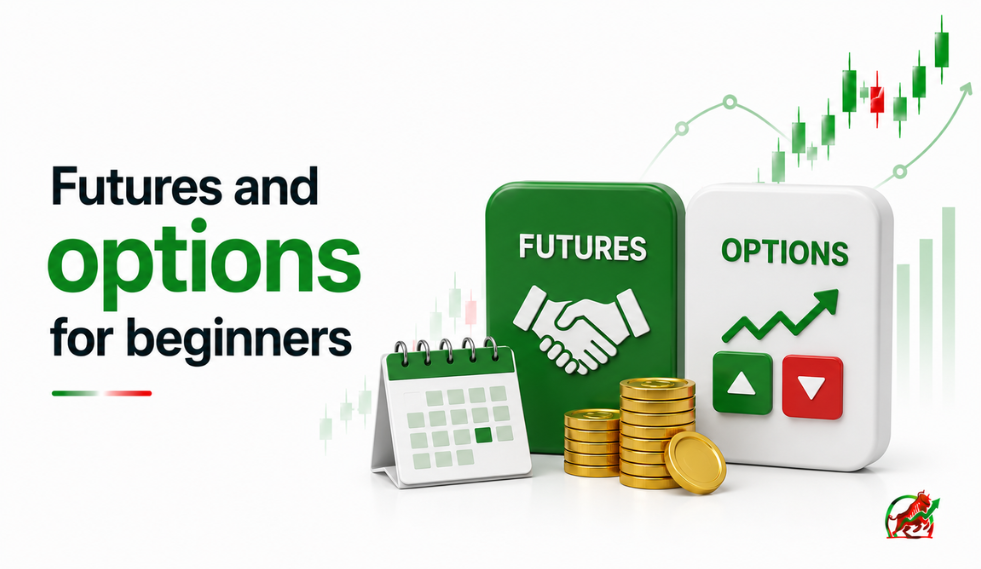
Futures and Options for Beginners

Trading & Markets
Summary Box
Futures and Options (F&O) are “derivative” contracts, whose value is linked to an underlying asset, such as a stock or market index. They allow traders to take a position on the future movement of that asset without buying or selling it directly.
Futures and Options trading allow market participants to take positions on stocks and indices (without ownership). In India, F&O contracts are traded on exchanges such as NSE and BSE, with standardised lot sizes and pre-defined expiry dates.
Futures generally require a “margin” to be paid upfront, while options involve paying a “premium” to the option seller. Depending on the contract, settlement may be in cash or through physical delivery of the underlying asset.
If you are a beginner, interested in Futures and Options trading, read this article to first understand what futures and options are (explained with easy examples) and their key features. Let’s start by learning what derivatives are.
F&O Basics: What are Derivatives?
To beginners, derivatives may seem complicated as they involve contracts rather than direct ownership of an asset. The basic idea, however, is simple:
A derivative is a contract whose price moves based on another asset, known as the “underlying asset”.
Stocks, market indices such as Nifty and Bank Nifty, commodities, and currencies can all serve as underlying assets. In India, “Futures” and “Options” are two major types of derivatives available to retail participants.
What is a Futures Contract?
It is an “obligation” instrument. A futures contract allows an investor or trader to take a position on the future price of an underlying asset, such as a stock or market index. Unlike an option, a futures contract creates an obligation for both parties:
The buyer and seller are required to honour the contract according to its terms.
Note that in futures trading, only a “margin” is required to be paid upfront. It is the amount of money that a trader must deposit with the broker to enter and maintain a futures position.
It acts as a security deposit and is only a fraction of the total value of the futures contract. The required margin can vary based on factors such as market volatility and exchange rules. To gain more clarity on F&O basics, let’s check out all the key features of Futures contracts:
| Feature | Explanation |
|---|---|
| Standardised Contract | The exchange determines important terms such as the: Lot size, Expiry date, Tick size, and Settlement method. |
| Obligation For Both Parties | The buyer and seller are both committed to the contract. A futures buyer must honour the contract even if the market moves against them. |
| Margin-Based Trading | The trader deposits a margin instead of paying the full value of the contract upfront. The required margin can change with market conditions. |
| Mark-to-Market (MTM) | Profit or loss is calculated and settled daily based on the change in the futures price. A loss may require additional funds to maintain the required margin. |
| Fixed Expiry | Every futures contract has a specified expiry date. The contract is settled according to the exchange’s rules on or before expiry. |
| Profit and Loss | The gain or loss depends on how far the futures price moves in the trader’s favour or against the trader. There is no fixed maximum loss for a futures position. |
Example
Suppose Nifty is trading at 24,000, and the futures lot size is 65. This leads to a total contract value of ₹15,60,000 (24,000 × 65). Now, the trader does not have to pay the entire ₹15,60,000 lakh upfront. Instead, a margin is required, with the exact amount depending on the exchange and prevailing market conditions.
Now, assume the trader buys one Nifty futures contract at 24,000. In futures and options trading, there could potentially be two different hypothetical scenarios:
| Scenario I: Suppose Nifty Rises to 24,300 | Scenario II: Suppose Nifty falls to 23,700 |
|---|---|
| The trader gains ₹19,500 (300 × 65) | The trader incurs a loss of ₹19,500 (300 × 65) |
What is Options Trading for Beginners?
It is the “right, not obligation” instrument. An options contract gives the buyer a right, but not an obligation, to buy or sell an underlying asset at a pre-decided price, known as the “strike price”. The buyer pays a premium for this right.
If the market moves in the expected direction, the option may generate a profit.
In contrast, if the market moves unfavourably, the buyer can choose not to exercise the option and lose only the premium paid.
The option seller, however, has an obligation if the buyer exercises the contract. To gain more clarity on F&O basics, let’s check out all the key features of Options contracts:
| Feature | Explanation |
|---|---|
| Call Option (CE) | Gives the buyer the right to buy the underlying at the strike price. It is generally used when the buyer expects the price to rise. |
| Put Option (PE) | Gives the buyer the right to sell the underlying at the strike price. It is generally used when the buyer expects the price to fall. |
| Strike price | The pre-decided price at which the buyer can buy or sell the underlying, depending on the type of option. |
| Premium | The amount paid by the option buyer to purchase the option. This is generally the maximum possible loss for the buyer if the option expires “worthless”. |
| Limited Risk for Buyer of an Options Contract | The buyer’s loss is generally limited to the premium paid. Whereas the potential gain can depend on the type of option and market movement. |
| High Risk for Seller of an Options Contract | The option seller receives the premium but takes on an obligation. A sharp adverse movement can result in substantial losses. |
| Time Decay | An option can lose value as its expiry approaches, particularly when other factors remain unchanged. This is known as “time decay”. |
| Expiry | Every option has a specified expiry date. If the option is not exercised or closed before expiry, it is settled according to the applicable exchange rules. |
Example
Suppose a stock is trading at ₹1,000. An investor expects it to rise and buys a ₹1,050 Call Option. Assume:
- Strike price: ₹1,050
- Premium: ₹20 per share
- Lot size: 500 shares
So, the total premium paid is ₹10,000 (₹20 × 500). In this case, the breakeven price is ₹1,070 (₹1,050 + ₹20). Now consider two potential scenarios:
| Scenario I: Suppose the Stock Rises to ₹1,100 | Scenario II: Suppose the Stock Falls to ₹1,020 |
|---|---|
| In this case, the Option’s value is ₹50 (₹1,100 − ₹1,050). The profit per share is ₹30 (₹50 – ₹20). So, the total profit is ₹15,000 (₹30 × 500). | The stock is below the ₹1,050 strike price. The investor did not exercise the call. The option expires worthless, and the loss is limited to the ₹10,000 premium paid. |
Futures and Options Trading 2026: How Do They Differ?
Both Futures and Options allow traders to take positions on the future price of an underlying asset. However, their rights, obligations, and risk profiles are different. The primary distinction?
A futures contract creates an obligation for both sides, whereas an option gives the buyer a right without creating an obligation to exercise it.
To better understand futures and options trading, let’s understand the various points below:
| Aspect | Futures | Options (Buyer) |
|---|---|---|
| Obligation | Both the buyer and seller are obligated to honour the contract. | The buyer has a right, but not an obligation. The option seller has the obligation if the buyer exercises. |
| Upfront cost | A margin is required to enter the position. | A premium is paid to purchase the option. |
| Maximum loss | There is no fixed maximum loss. Importantly, losses can increase as the market moves against the position. | The buyer’s maximum loss is generally limited to the premium paid. |
| Profit potential | Profit or loss generally changes “point-for-point (M2M)” with the underlying, subject to the contract terms. | Profit depends on the option type, strike price, premium, and movement in the underlying. |
| Time decay | Time decay does not directly reduce the value of a futures position. | Time decay can reduce an option’s value as expiry approaches. |
Do Nifty Futures and Options Trading (NFO) At Zero Brokerage!
Register Today on Trade246
So, now you know what Futures and Options trading are and how these two derivative instruments work. To revise, both futures and options are financial contracts whose value is linked to an underlying asset, such as a stock or index.
However, they primarily differ as follows:
- In Futures, both parties are obligated to honour the contract, with gains and losses based on price movements. Whereas, in Options, the buyer gets a right without an obligation and pays a premium for that right.
- Futures contracts require “margin” and do not have a predefined maximum loss. In contrast, an Options buyer’s maximum loss is generally limited to the “premium” paid, although the option seller can face higher losses.
If you are looking for an online platform for Nifty futures and options trading, consider Trade246. The platform supports 7 market segments, including NFO, where you can track live prices and trade NIFTY FUT, BANKNIFTY FUT, FINNIFTY FUT, RELIANCE FUT, TCS FUT, and INFY FUT.
Trade246 also offers ultra-low-latency order execution with 99.9% uptime, along with “bank-grade” security (which includes 256-bit encryption, 2FA authentication, and segregated client accounts). Register today and explore the platform.
Futures and Options Trading FAQs
1. What are Derivatives?
2. What is a Futures Contract?
3. What is an Options Contract?
4. Why do investors do Futures and Options Trading?
5. Is options trading for beginners safe?
Risk Warning: Trading in financial instruments carries a high level of risk to your capital and the possibility of losing more than your initial investment. Trading in financial instruments may not be suitable for all investors and is only intended for people over 18. Please ensure that you are fully aware of the risks involved and seek independent advice if necessary. Past performance is not indicative of future results.