
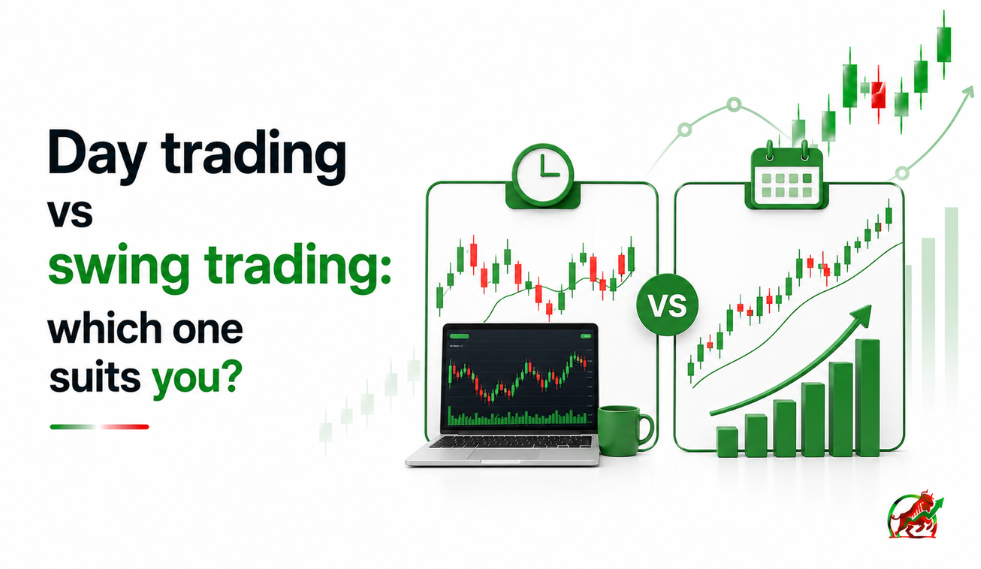
Day trading vs swing trading: which one suits you?

Summary Box:
| Intraday vs swing trading are two different trading styles for exploiting potential short-term market opportunities. “Intraday” trades are completed within the same trading day, whereas “swing” trades remain open from several days to a few weeks. The choice depends on the trader’s strategy, level of market knowledge, and risk tolerance limit. |
There is no single way to trade. Market participants follow different trading styles, such as scalping, day trading, swing trading, momentum trading, and more. Among these, day trading and swing trading are widely followed by traders who seek to profit from short-term market movements.
Both these trading styles differ in holding periods, time commitment, and the way trades are planned and managed. Want a detailed explanation? Read this article to first understand what day trading and swing trading are, and then see how they differ. Lastly, you will learn which trading style may potentially suit your time availability, risk tolerance, and trading objectives.
What is Day Trading?
Day trading (also known as intraday trading) is the technique of buying and selling an investment within the same trading day. Unlike investing, where an investor may hold a stock for months or years, a day trader closes the position before the market session ends.
The potential aim? It is to benefit from price movements that occur during the day. In this trading style, positions may be held for a few seconds, several minutes, or a few hours, depending on the price movement and trading strategy.
Generally, day traders use stop-loss and take-profit orders to manage their trades. A stop-loss order can automatically close a position when the price reaches a pre-set loss level. For example,
- Suppose a trader buys at ₹500 and sets a stop-loss at ₹495.
- Next, they set a take-profit order to close the position when the price reaches ₹510.
In this way, generally, day traders set their loss and profit levels before entering a trade.
4 Most Followed Day Trading Strategies 2026
While practicing day trading, market participants use different strategies based on:
- Price movement
- Market trends, and
- Trading volume
The choice of strategy depends on how long a trader plans to hold a position and what type of price movement they expect. For more clarity, let’s check out the four most common day trading strategies:
| Day Trading Strategy | How It Potentially Works | General Holding Period | General Examples |
| Scalping | May involve taking several trades to capture minor price movements and earn small profits from each trade. | Seconds to a few minutes | Buying a stock at ₹500 and selling it at ₹501 when a short-term price rise occurs. |
| Momentum Trading | May involve trading in the direction of a strong price movement. Traders may buy when prices show strong upward momentum or sell when prices show strong downward momentum. | Minutes to a few hours | Buying a stock after strong buying activity pushes its price higher.The expectation is that the upward move may potentially continue. |
| Breakout Trading | May involves entering a trade when the price moves beyond an important support or resistance level.The trader may expect the price to continue in the direction of the breakout. | Minutes to a few hours | Buying a stock when it moves above a resistance level of ₹500.The expectation is of potential further price gains. |
| Technical Indicator-Based Trading | Uses indicators such as RSI, VWAP, moving averages, and candlestick patterns to identify possible entry and exit points. | Varies from minutes to several hours | Buying a stock when its price moves above a moving average and other indicators support the trade. |
What is Swing Trading?
Swing trading is a short-term trading approach in which a trader buys a stock and holds it for several days or weeks rather than selling it on the same day. The potential aim? It is to benefit from a rise or fall in the stock price during this period. Unlike day trading, a swing trader:
- Keeps the position open beyond one trading session
and
- Accepts the risk of price changes between market sessions.
As per general industry understanding, swing trading sits between day trading and long-term investing (in terms of holding period). It may potentially suit market participants who want to realise gains from short-term price movements without entering and exiting trades within the same day.
However, since positions remain open for several days or weeks, the trader remains exposed to price movements during that period.
How Does Swing Trading Work? Step-by-Step Process 2026
Firstly, potential stocks for swing trading are selected. Generally, swing traders look for stocks that show strong price movement, rising trading activity, or signs of a developing trend. “Stock screeners” may be used to filter stocks based on factors such as price movement, volume, and other selected criteria.
Once the “right” stocks are selected, traders generally follow these three steps:
| Step I: Decide Entry and Exit Levels | Step II: Hold the Position | Step III: Book Potential Profits or Limit Losses |
| After selecting a stock, the trader decides at what price to enter and when to exit.Potential buying and selling points are identified using:Support and resistance levelsChart patterns, andTechnical indicators | Unlike day trading, the position remains open for several days or sometimes a few weeks. The trader holds the stock as long as the expected price movement remains valid. Market conditions can affect how long the position is held. | The position may be closed when the stock reaches the desired price target.A stop-loss can also be used to limit the potential loss if the trade does not work as expected. |
Intraday vs. Swing Trading: How Do They Differ?
Intraday trading (or day trading) and swing trading are both “short-term” trading approaches, but the primary difference lies in how long a position is held.
- In intraday trading, a trader buys and sells within the same market session and does not carry the position overnight.
- In swing trading, the position remains open for several days or weeks.
This difference affects the time required, the risks involved, and the way traders analyse potential trades. For more clarity, let’s understand intraday vs swing trading in detail:
| Particulars | Intraday Trading | Swing Trading |
| General Process | Buying and selling a financial instrument within the same trading session to benefit from short-term price movements. | Buying and holding a financial instrument for several days or weeks to benefit from a larger price movement. |
| Holding Period | Less than one trading day. Positions are generally closed before the market closes. | Usually, several days to a few weeks. Positions remain open beyond a single trading session. |
| Main Objective | Capture small price movements that occur during the day. | Capture a larger price movement that develops over several days or weeks. |
| Overnight Risk | Potentially, minimal overnight position risk because trades are closed before the session ends. | Higher exposure to overnight risk because the position remains open after the market closes. News or other events can cause the price to open at a different level the next day. |
| Analysis Used | Price chartsTrading volumeTechnical indicatorsMarket newsShort-term price patterns | Technical analysisChart patternsSupport and resistance levelsBroader market trends |
| Nature of Risk Exposure | Exposed to intraday price fluctuations. Multiple trades can also lead to cumulative losses. | Exposed to both normal price movements and overnight events, including gaps between one day’s closing price and the next day’s opening price. |
Intraday vs. Swing Trading: What You May Practice in 2026?
The potentially “right” choice between day trading and swing trading depends on how much time, attention, risk tolerance, and capital a person can commit. Still, if you need a reference, refer to the points below:
| When to Potentially Consider Day Trading | When to Potentially Consider Swing Trading |
| Prefer to close all positions before the market closes.Can make + follow predefined entry and exit decisions during the session.Can tolerate adverse short-term price fluctuations.Can maintain strict stop-loss and position-size rules for each trade.Have the time and temperament required for active trading. | Cannot monitor the market throughout the trading session.Are comfortable holding positions for several days or weeks (instead of intraday).Can tolerate overnight price movements and the risk of price gaps.Can analyse price trends, support and resistance, volume, and chart patterns.Can set an entry price, target, and stop-loss before holding a position. |
Looking to Trade With “Zero” Brokerage? Open Your Free Trading Account on Trade246
So, now you know what swing and day trading are and how they differ from each other. If we were to revise, both are short-term trading approaches, but they differ in how long a position is held. In day trading, positions are opened and closed within the same trading day, while in swing trading, positions may be held for a few days or weeks.
The “right” choice? It depends on the trader’s time availability, risk tolerance, market knowledge, and preferred trading style. If you are searching for an online trading platform offering “zero-brokerage”, choose Trade246. We support trading across 7 different market segments: NSE, NFO, Forex, Commodities, Crypto, US Stocks, and Indices.
Additionally, get up to 500X leverage and enjoy a 99.9% platform uptime (with ultra-low latency order execution). Register and open your free trading account today!
Day Trading FAQs
1. Is day trading more difficult than swing trading?
As per general industry understanding, day trading can require a greater time commitment because traders need to monitor price movements and make decisions during market hours.
In contrast, swing trading may offer comparatively more time to analyse trades because positions may remain open for days or weeks. However, both require discipline and risk management.
2. Is day trading suitable for beginners?
Day trading for beginners can be challenging as it requires:
- Taking quick trading decisions (as positions need to be closed before the end of the trading day)
- Frequent market monitoring, and
- Strict risk management
Ideally, beginners should first learn market basics and practise with a demo trading account.
3. How should traders set their entry and exit prices?
Traders may set an “entry price” based on factors such as support, resistance, breakouts or other technical signals. In comparison, the “exit price” may be based on a realistic profit target and a stop-loss level.