
Stock Market Timings in India: Sessions Explained

Summary Box:
| For the regular equity market on NSE and BSE, the share market timings are from 9:00 a.m. to 3:30 p.m. IST, including the pre-market session. NSE also provides a separate closing session from 3:40 p.m. to 4:00 p.m. for eligible securities. These timings generally apply from Monday to Friday, excluding exchange-declared trading holidays. Besides, special schedules may also apply for Muhurat Trading, special sessions, or particular market segments. (Source: NSE India – Market Timings) |
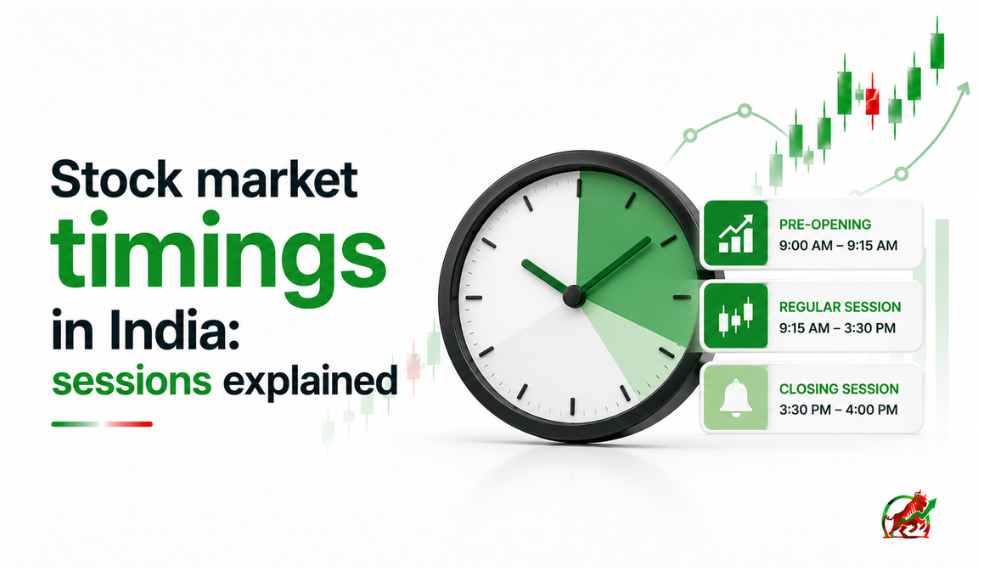
On both NSE (National Stock Exchange) and BSE (Bombay Stock Exchange), the trading day begins with the pre-open session, moves into continuous trading, and concludes with a closing session.
Besides, block deals also have designated windows, while currency, commodity, and securities-lending markets follow their own schedules. Read this article to check out the latest share market timings in India, what happens during each session, and how orders are matched.
What are the Latest Share Market Timings 2026?
In India, equity trading is divided into three major sessions:
- Pre-market session
- Regular trading
- Closing session
Let’s check out the latest share market timings 2026 (Source: NSE India – Market Timings):
1) The Pre-Market Session Runs From Between 9:00 and 9:15 a.m.
Before normal trading starts at 9:15 a.m., the NSE conducts a 15-minute pre-market session (also known as pre-opening). Its purpose is to collect orders and use them to determine the opening price of eligible securities.
As per general industry practice, the pre-market session may happen as follows:
| Phase | Time | What Happens |
| Order Collection | 9:00 to 9:08 a.m. | Investors can start placing buy and sell orders from the NSE opening time of 9:00 a.m.They can also modify or cancel eligible orders during this period. |
| Random Closure | Between 9:07 and 9:08 a.m. | The order-collection period ends at a system-determined random time during the final minute. This prevents participants from knowing the exact cut-off time. |
| Order Matching | After order collection, until about 9:12 a.m. | The exchange matches eligible buy and sell orders. Based on these orders, it determines the equilibrium price, which becomes the opening price for the regular market, subject to NSE’s rules. |
| Buffer Period | About 9:12 to 9:15 a.m. | The exchange completes the transition from the pre-open session to normal trading. Regular market trading begins at 9:15 a.m. |
Note: During the order-collection period (9:00 to 9:08 a.m.), investors can enter orders and make changes or cancellations. However, once order collection ends and order matching begins, new orders generally cannot be added, modified, or cancelled.
The exchange then uses the available orders to find a price at which the maximum possible quantity of shares can be matched. This process establishes the security’s opening price before continuous trading starts at 9:15 a.m.
2. Normal or Continuous Trading Runs From 9:15 a.m. to 3:30 p.m.
After the pre-market session ends, the stock market enters its normal trading session, which runs from 9:15 a.m. to 3:30 p.m. on both the NSE and BSE. During these hours, investors can place buy and sell orders, and the exchange matches compatible orders throughout the session.
Most equity transactions, whether for intraday trading, delivery, or positional investing, take place during this period. Let’s understand in detail:
| Aspect | What Happens |
| Share Market Timings | The normal equity market operates from 9:15 a.m. to 3:30 p.m. |
| How Orders are Matched | Buy and sell orders are matched continuously whenever compatible orders are available. |
| Price Priority | An order offering a better price gets priority.For a buyer, a higher buying price has priority.For a seller, a lower selling price has priority. |
3. Block Deal Windows
A block deal is a large transaction in which a substantial number of shares are bought or sold as a single trade or through a set of linked trades. Since such transactions can involve large quantities, exchanges provide designated time windows with specific rules for their execution and reporting.
Let’s check them out:
| Exchange/ Window | Timing | What it Means |
| NSE – Block Deal Session 1 | 8:45 to 9:00 a.m. | This window takes place before the normal equity market opens at 9:15 a.m.Eligible block deals can be executed during this period. |
| NSE – Block Deal Session 2 | 2:05 to 2:20 p.m. | This window takes place during the normal trading session, in the latter part of the trading day. |
Note: On BSE, the block deal window operates during the initial 35 minutes of the continuous trading session, from 9:15 a.m. to 9:50 a.m.
4. Stock Market Closing Time Runs from 3:40 p.m. to 4:00 p.m.
The “closing session” is a separate trading window that starts after the normal equity market closes at 3:30 p.m. On the NSE, the stock market closing time runs from 3:40 p.m. to 4:00 p.m. for eligible securities.
Realise that it is not an extension of the normal share market timings. Let’s understand in detail:
| Aspect | What Happens |
| Normal Market Closes | Regular equity trading ends at 3:30 p.m. |
| Gap Before Closing Session | There is a 10-minute interval from 3:30 p.m. to 3:40 p.m. before the closing session starts. |
| Closing Session | Runs from 3:40 p.m. to 4:00 p.m. for eligible securities. |
| Who Can Use It | Only securities and order types permitted under NSE’s closing-session rules can be traded during this period. |
| Trade Modification Cut-Off | NSE lists 4:15 p.m. as the trade-modification cut-off for members. Generally, ordinary investors can place fresh equity trades until 4:15 p.m. |
Timings for Other Securities and Derivatives
Apart from the regular equity market, NSE also provides trading facilities for currency derivatives, commodity derivatives, and securities lending and borrowing (SLB). These markets have different trading hours from the regular share market timings.
Let’s check them out:
| Market | Trading hours | What it Means |
| Currency Derivatives | Starts at 9:00 a.m.; closing time varies by product | Currency futures and options are traded from 9:00 a.m.The closing time depends on the specific currency derivative, with some contracts available until the evening. |
| Commodity Derivatives | Starts at 9:00 a.m.; closing time varies by commodity | Trading hours differ across commodity categories.Non-agricultural commodities can trade into the evening.Timings can also vary with the seasonal change in US daylight-saving time. |
| Securities Lending and Borrowing (SLB) | 9:15 a.m. to 5:00 p.m. | This market allows eligible securities to be lent and borrowed through the exchange.Its trading window extends beyond the regular equity market, which closes at 3:30 p.m. |
(Source: NSE India – Market Timings)
Want to Trade With Zero Brokerage? Access 7 Different Market Segments on Trade246
So, now you know about the latest share market timings applicable in India. If we were to revise, the share market timings can be divided into three major sessions:
- Pre-Market Session (9:00 to 9:15 a.m.): Orders are collected and matched to determine the opening price before regular trading begins.
- Regular Trading Session (9:15 a.m. to 3:30 p.m.): Buy and sell orders are matched continuously based on price-time priority.
- Closing Session (3:40 to 4:00 p.m.): A separate session for eligible securities after regular equity trading ends.
Apart from these, investors should also know about the “block deal” windows, which provide designated periods for large transactions. Currently, NSE has two block-deal windows: 8:45 to 9:00 a.m. and 2:05 to 2:20 p.m.
If you are looking to trade at zero brokerage, register for free on the Trade246 platform. Here, you can trade across 7 market segments: Forex, NSE, NFO, Commodities, Crypto, US Stocks & Indices. Also, enjoy up to 500X margin, 99.9% platform uptime, and ultra-low-latency order execution.
Share Market Timings FAQs
1. How is the opening price determined in the share market?
The opening price is known as the “equilibrium price”. It is normally the price at which the maximum number of shares can be traded based on the buy and sell orders received during the pre-market session.
2. How does “price-time” priority work in the share market?
The general rule is: Price comes first, and time comes next. Let’s understand better through two scenarios:
- Suppose two investors want to buy the same stock. One places a buy order at ₹500, while another places it at ₹502. The ₹502 order has higher priority because it offers the seller a better price.
- Suppose there are two investors and both placed buy orders at ₹502. If Investor A places the order at 10:00 a.m. and Investor B at 10:02 a.m., Investor A’s order gets priority because it was entered first.
The same principle applies to sell orders. A seller offering the stock at ₹500 generally has priority over another seller offering it at ₹502, because the ₹500 price is better for a buyer.
3. What are the share market timings for “block deals” on NSE and BSE?
A block deal is a large transaction executed through a designated block-deal window rather than through the ordinary continuous trading process.
- On NSE, there are two 15-minute block-deal windows: 8:45 to 9:00 a.m. and 2:05 to 2:20 p.m.
- On BSE, block-deal orders can be entered during the first 35 minutes of the continuous trading session, from 9:15 a.m. to 9:50 a.m.